What is Email Bombing – Bitdefender TechZone
2026-09-18
Email bombing floods inboxes with legitimate transactional emails via subscription bombing or SMTP flooding to bury fraud or enable vishing—400+ clean emails hiding a phishing email or supporting a fake IT helpdesk call. Detection requires per-recipient rate limiting and timing correlation.
Email bombing is an attack technique where adversaries flood a target's inbox with hundreds or thousands of emails in a short timeframe. Security teams routinely file it as spam, which is what makes it work: the flood is rarely the goal. Attackers use it to bury a malicious email under noise the victim will not read, or to panic a user into taking a call from someone claiming to be responding to the flood. The emails themselves are usually clean, often genuine, and there is nothing in them to detect.
Email Bombing Example
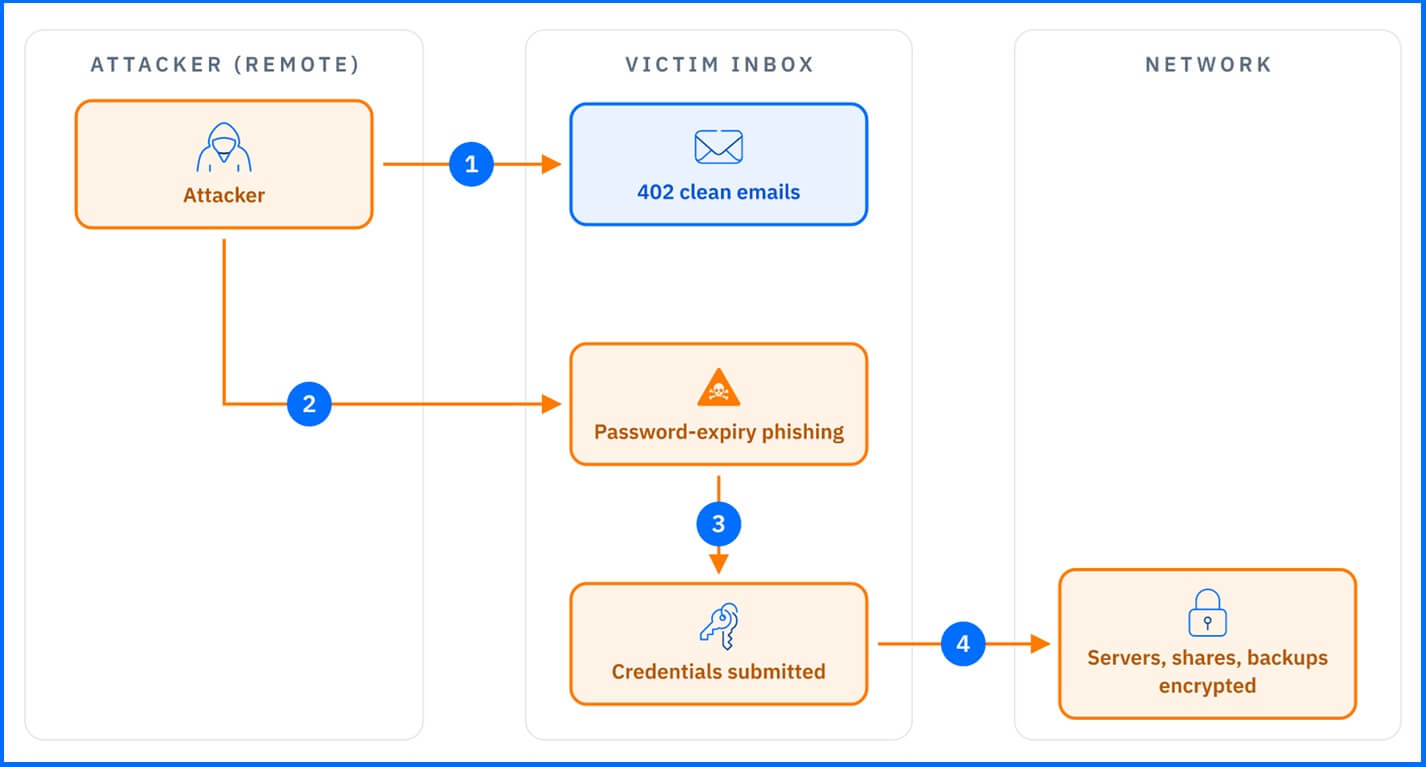
The investigation began at the worst possible point: every server, file share, and backup encrypted. The entry point was not a zero-day. Weeks earlier, an employee had typed his domain credentials into a fake sign-in page after a routine-looking "password expires today" notice. That email hadn't arrived alone. Between 9:47 and 11:05 AM, the user's inbox had received 402 messages — newsletter confirmations, password reset notifications, shipping updates, account verification prompts — all from legitimate-looking services, none carrying malware or a malicious link. The credential-phishing email arrived at 10:08, in the middle of the surge, and was itself a password-expiry notice: indistinguishable at a glance from the genuine reset notifications stacked around it. The user, working through an inbox that had become unmanageable, took it for one more reset prompt and submitted his credentials.
No signature matched anything in the flood. The signal was behavioral, and it was timing: 402 clean emails arriving around one credential submission is not a coincidence. It is cover for initial access.
 |
What Email Bombing Is
Email bombing requires no malware, no exploit, and no compromise of the victim's account. The attacker sends or triggers high volumes of email to a specific recipient, and the attack succeeds on volume alone. That separates it from three things it gets filed under: phishing uses a single malicious email to deceive the user; outbound spam abuse runs through a compromised account sending to external recipients; mass spam campaigns hit thousands of recipients indiscriminately. Email bombing targets one person, from outside, and frequently with mail that is genuine.
The distinction that matters for detection: the flood carries no payload and no link, and in subscription bombing every sender is a real service with valid authentication — so content analysis has nothing to act on. Detection depends on volume measured against the user's own baseline, and on timing measured against what else happened to that account in the same window. No individual message is the attack. The volume is.
How Email Bombing Works
Email bombing splits into two patterns based on the email source, and sophisticated attackers run both at once — subscription bombing for bulk the defender cannot blanket-block, SMTP flooding to top up volume or land timed distractions. Each leaves different artifacts, so detection has to track both.
Subscription Bombing
The attacker automates sign-ups across legitimate web services — newsletters, e-commerce confirmations, account creation flows, password resets — targeting the victim's email address. The victim receives hundreds of emails from real companies (Shopify, PayPal, LinkedIn), all triggered by automated form submissions.
Every email is legitimate. The sending domains carry valid SPF records (specifying which IPs may send for the domain), DKIM signatures (cryptographic proof of message integrity), and DMARC policies (enforcement tying SPF and DKIM together). Content-based spam filters see normal transactional email and pass it through. Volume is the only anomaly, and volume alone does not trigger most email security controls unless per-recipient rate limiting is explicitly configured.
The technique is possible because most web services allow unlimited account creation or password reset requests without rate limiting per target email address. An attacker can script sign-ups across thousands of services in minutes. The legitimate services become unwitting flood sources.
SMTP Flooding
The attacker controls mail servers directly and sends email from attacker-owned infrastructure. Sender addresses may be spoofed or use throwaway domains. The content is typically generic — account verification prompts, shipping notifications, password reset messages — but contains no malware and no phishing links. Signature-based detection has nothing to flag.
The attack is possible because SMTP was designed for open relay before spam became the dominant email threat. Modern mail servers reject open relay, but attackers rent infrastructure from providers, use compromised servers as relays, or exploit misconfigured cloud instances. Sending 10,000 emails in ten minutes is operationally trivial from an attacker-controlled SMTP server.
Reputation-based filtering may eventually blacklist sending IPs, but reputation services track complaint rates and sending patterns across many mailboxes — building sufficient negative signals to trigger a block can take hours or days, long after a ten-minute targeted flood has succeeded.
Email Bombing as Operational Cover
The flood is not the goal. The flood is stage one. Two patterns recur.
Burying fraud notifications. An attacker compromises an internal account, spoofs an internal sender, or simply times a fraudulent email to land inside the flood. The victim sees the preview, takes it for more of the same, and never scrutinizes it. The email succeeds not because it evaded a control, but because it was never read. Subscription bombing is the preferred cover, because transactional mail — sign-up confirmations, resets, shipping notices — blends into a flood of transactional mail more naturally than marketing does. Standard triage makes it worse: block the sender domains, clear the mailbox, close the ticket. The one email that mattered leaves with the rest.
Vishing setup. The attacker floods the inbox, then calls posing as IT support: "We're seeing unusual activity on your account — a large volume of emails in the last ten minutes. We need to verify your credentials to stop the attack." The victim, staring at exactly that, complies. No malicious email is ever sent. The flood is what makes the caller credible — it is visible, corroborating evidence that something is happening, and a caller who claims to be responding to it inherits the victim's own conclusion. The flood creates the panic; the call spends it. Why analysts miss it: phone logs and email logs rarely reach the same platform. A SOC analyst sees a volume spike. A phone administrator sees an inbound call. Neither correlates the two without deliberate cross-channel investigation, and that gap is the attack
Common Mistakes and Misconceptions
"Email bombing is always random spam"
Email bombing can be precision-targeted. These are not spray-and-pray campaigns: attackers select the victim, script the flood to hit inside a specific time window, and often coordinate it with a follow-on action timed to arrive in the middle of it. The correct mental model: email bombing is a technique, not a content type. The flood may be strategically timed and aimed at one person during one operational window, and look, message by message, like an ordinary week of transactional mail.
"If there's no malware, there's no threat"
Dismissing inbox floods because the emails contain no malicious payload is the most common triage error, and it is the error that makes operational cover attacks succeed. A wire transfer approval buried under 2,000 newsletter confirmations does not need malware; the fraud succeeds because the victim never scrutinized a legitimate-looking email. A vishing call following an inbox flood does not need a phishing link; the panic is the exploit.
"Spam filters will stop email bombing"
Standard spam filters are content-focused. They flag phishing links, malicious attachments, spoofed domains, and known-bad senders. Subscription bombing uses legitimate services with valid SPF, DKIM, and DMARC authentication, so content analysis has nothing to flag. SMTP flooding sends clean text with no payload. Rate limiting, configuring per-recipient inbound volume thresholds, is the required control, and it is not enabled by default in most email platforms. Reputation-based filtering may eventually blacklist SMTP flood sources, but a ten-minute targeted attack succeeds long before reputation signals accumulate.
"A volume spike means the user is under attack"
Not on its own. A conference registration, a newly joined distribution list, or a Black Friday promotional wave all produce the same shape: hundreds of transactional emails from real senders in a compressed window. That is why volume alone rates Medium below. An alert on volume with no second signal will bury a SOC in noise and train analysts to close the alert that matters. What separates the two is not the flood; it is what else happened to that account inside the window. A spike beside a password reset, an MFA prompt, a financial approval, or an inbound phone call is an incident. A spike beside nothing is a Tuesday.
What Reliable Email Bombing Signals Look Like
A typical corporate mailbox receives 50 to 200 emails per day spread across working hours; distribution lists produce short bursts of 20 to 50, and sustained high-volume inbound is rare for an individual user. The working heuristic is an inbound rate exceeding 10x the user's daily average inside a single 30-minute window — a 100-email-per-day user receiving 500 in half an hour. Each signal below is rated against that baseline.
Signal | Reliability | Notes |
|---|---|---|
Inbound volume spike against the user's baseline | Medium | The only indicator common to both attack patterns; legitimate bulk events — large distribution lists, conference registrations, promotional surges — produce false positives. |
Temporal correlation with a sensitive action | High | A password reset, MFA prompt, privilege change, financial approval, or inbound phone call inside the flood window; this is what turns the volume spike from noise into an incident. |
Sender diversity | Medium | Dozens to hundreds of distinct domains indicates subscription bombing; a small set of IPs or domains indicates SMTP flooding. Classifies the attack rather than detecting it. |
Authentication records (SPF, DKIM, DMARC) | Low | May fail on SMTP flooding, but passes cleanly on subscription bombing, where every sender is a real service. Silent against the more common pattern. |
Content analysis | Low | Transactional confirmations and generic notification text carry no payload and no link. Nothing to match. |
Reliability: High means the signal produces very few false positives against a standard corporate mailbox baseline. Medium means legitimate activity triggers it and correlation or tuning is required. Low means the signal is insufficient as a standalone detection.
When a flood is detected, review the emails that arrived inside the window for spoofed internal senders, fraudulent approvals, and credential reset prompts the user did not initiate; check account activity logs for password changes, MFA enrollment, privilege grants, and financial approvals in the same window; and establish whether the user received an inbound call during or immediately after it. The call is the item most likely to be missed, because phone logs and email logs rarely reach the same platform.
Mitigation
No control below inspects message content, because in an email bombing attack there is nothing in the content to find. Each one acts on volume, on timing, or on the person the flood is aimed at.
Enable per-recipient rate limiting. Configure inbound thresholds against your own baseline — a user averaging 50 to 100 per day warrants investigation at 200 per hour. Quarantine what exceeds it for review rather than delivering it into an already-unmanageable inbox. This is the required control, and most platforms leave it off by default.
Baseline per-user inbound volume and alert on deviation. This catches subscription bombing and SMTP flooding alike, regardless of message content, because volume is the only indicator the two patterns share.
Treat a reported flood as stage one. Until investigation proves otherwise, assume the flood is cover. Pause inbound delivery to the mailbox during triage, and review account activity and the emails inside the window before closing the ticket as spam. Train users to report a flood immediately rather than waiting for it to subside.
Verify any call that arrives with the flood through a separate channel. Slack, a directory lookup, or a callback to the official IT number. Never provide credentials or MFA codes to an inbound caller, whatever they claim to be seeing — the flood is the reason the caller sounds credible, not evidence that they are.
Restrict external Teams access. Microsoft 365 permits users on external domains to start chats and calls with internal users by default, and that default is what lets a flood be followed by a credible helpdesk contact inside a platform the victim already trusts. Limit it to known business partners, and restrict remote-access tools such as Quick Assist by policy unless your support team uses them.
Correlate email telemetry with authentication, financial approval, and phone logs. A volume spike means nothing in isolation; a volume spike immediately preceding a wire transfer approval is a high-confidence incident. This correlation layer is what catches operational cover attacks that single-channel monitoring misses.
GravityZone Detection
Bitdefender GravityZone addresses email bombing through two layers: Extended Email Security controls at the delivery layer, and XDR behavioral correlation across email and endpoint telemetry.
Extended Email Security acts at the delivery layer, enforcing an inbound rate limit and temporarily deferring messages that exceed it. In a subscription-bombing flood every sender is legitimate and every message authenticates cleanly, so volume is the only thing left to act on — and this is the control most platforms leave off by default.
XDR behavioral correlation is the layer that catches the attack in the opening example. GravityZone correlates endpoint authentication events — password changes, MFA prompts, privilege grants — with email telemetry collected through the Office 365 sensor. A volume spike means nothing alone; a volume spike whose window contains a credential submission is an incident. The fraudulent email buried under 402 clean ones becomes visible not through its content, which is unremarkable, but through its timestamp landing inside a flood that coincides with a sensitive account action.