What is Content Injection – Bitdefender TechZone
2026-10-02
MITRE T1659 Content Injection uses Man-in-the-Middle interception or Man-on-the-Side DNS/TCP injection to substitute payloads in transit. Defense requires HTTPS enforcement, DNSSEC, encrypted DNS transport, and network-level detection of anomalies.
A client that resolves a name and fetches a file is making two acts of faith: that the answer came from the server it asked, and that the bytes it received are the bytes that were sent. Neither is verified by default. DNS carries no authentication; plain HTTP carries no integrity check. Content injection (MITRE ATT&CK T1659) is the family of techniques that exploits this vulnerability—an adversary on the network path supplies its own answer or rewrites the response in transit, and the client accepts it because it has no mechanism to do otherwise. No software bug is exploited. No vulnerability is triggered. The server behaves correctly throughout. The attack is the position: the adversary attacks the path, not the endpoints, which is why neither party detects it.
Content Injection Example
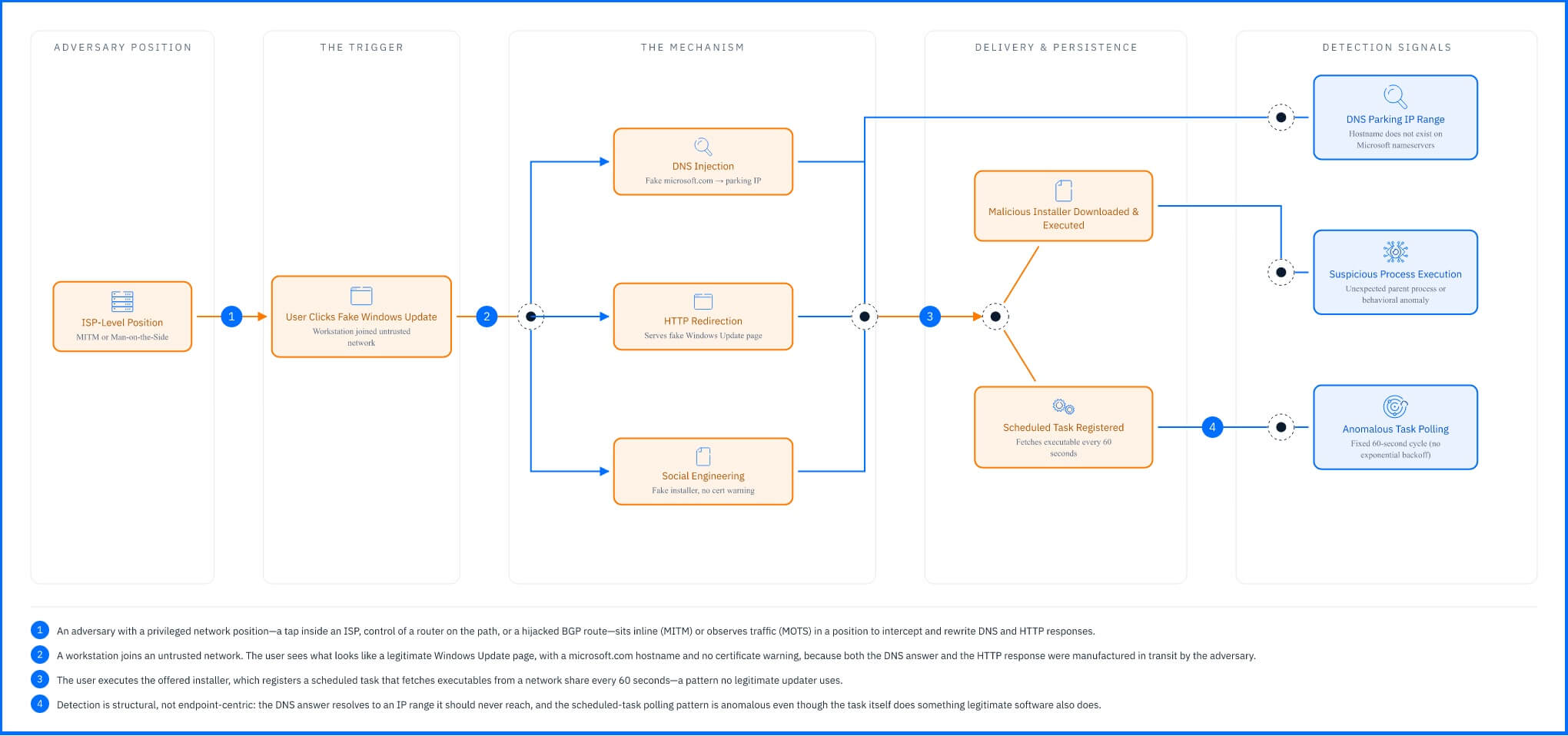
A Tier-1 analyst pulls the alert. A workstation joined an untrusted network eleven minutes ago; a browser opened onto what looked like a Windows Update page, the address bar showed a microsoft.com hostname, and with no certificate warning, the user clicked. Endpoint telemetry reconstructs the rest: a file landed in the Downloads folder, the user executed it, it registered a scheduled task, and that task began pulling an executable from a network share every sixty seconds—each step, alone, something legitimate software does.
Two signals break it open anyway. First, that hostname does not exist on Microsoft's nameservers, and the answer the workstation received resolved into a parked-IP range. Second, the scheduled task fetches on a fixed one-minute cycle, which no legitimate updater does.
Neither is visible on the endpoint at the moment of delivery, and neither involves the browser. Both the DNS answer and the HTTP response were manufactured in transit at the ISP level by an adversary with a tap on the wire. This was not a compromise of the update mechanism—it was a compromise of the road the update mechanism drives on.
 |
How a Client Finds and Trusts a Server
Name resolution has no authentication by default. A stub resolver sends a UDP query and accepts a reply that arrives from the expected address and port, carrying a matching 16-bit transaction ID and question. None of these are signatures; they are values, and an attacker who knows them can supply them. An off-path attacker has to guess the transaction ID and source port together. An attacker who can observe the query guesses nothing—both are on the wire in front of them. That is why position matters more than protocol sophistication.
Nothing binds the answer to the authoritative source. The resolver accepts the first reply that matches and discards later ones as duplicates. It does not ask whether the answer is correct, only whether it looks like one. And it caches what it accepts, serving it to every client behind it until the record expires, so a single forgery accepted once persists and spreads. DNSSEC adds the missing check, but it must be deployed at the zone and validated by the resolver—and neither is universal.
Transport integrity is optional, and negotiated after resolution. TLS closes the payload-rewriting gap that plain HTTP leaves open—but the client only knows which server to open a TLS session with because DNS already told it. Anything that corrupts resolution has acted before validation begins.
Certificate validation checks the name, not the route. A certificate asserts that its holder controlled the name at the time of issuance. It asserts nothing about whether the client reached the right address. Redirection alone therefore does not defeat TLS—only redirection paired with a certificate the adversary should not have been able to obtain.
What Content Injection Is
Content injection is not an exploit technique and it does not attack a flaw in the target application or operating system. The server is behaving correctly. The adversary modifies traffic between client and server at the infrastructure level, by controlling a hop on the path, by injecting counterfeit responses, or by replacing payloads in transit. The malicious property is not in anyone's code. It is in the network position the adversary holds and the unencrypted protocols that make modification possible.
This is primarily a nation-state or well-resourced-actor capability. A privileged network position — a tap inside an ISP, a hijacked route, control of a router on the path — requires access that places content injection outside commodity attacker territory.
How Content Injection Works
Position on the path is necessary but not sufficient. The adversary must also be able to act on traffic, and there are two ways to do that. They differ in what they require, what they leave behind, and how they are caught
Man-in-the-Middle (MITM)
Mechanism. The adversary sits inline. Traffic flows through adversary-controlled infrastructure, and the adversary terminates, inspects, rewrites, and forwards it. A client sends an HTTP GET for a software installer; the adversary receives the request, retrieves the legitimate binary from the real server, substitutes a malicious payload, and returns the modified response. Both endpoints believe the exchange was ordinary. In the strongest version, the adversary does not forward anything at all: the request is answered locally and never reaches the internet, so the "legitimate server" plays no part in the transaction. Either way, the position has to be held. The adversary must stay on the route for the life of the connection, which is why inline interception implies durable control of a router, a switch, or ISP infrastructure rather than a transient foothold.
Why this is possible. Plain HTTP has no integrity protection over its payload, and DNS has no authentication over its answers. A party that handles the traffic can rewrite either. Nothing in the protocols gives the client a way to detect the substitution, because nothing in the protocols was designed to.
Detection angle. Inline interception is the harder of the two to see on the wire, because it produces no duplicate and no anomaly in the packet stream—the adversary controls both sides of the exchange. The reliable signals are semantic rather than structural: a DNS answer that places a well-known service in an IP range it has no business in, a certificate chain that does not match expectation, or a payload whose signature does not validate. Endpoint-side, the signal arrives only after execution.
Man-on-the-Side (MOTS)
Mechanism. The adversary does not handle the traffic. It observes, and when it sees a query worth answering, it emits a forged reply and races the legitimate response. A client sends a DNS query for update.example.com; the adversary, watching the wire, injects a counterfeit answer pointing at an address it controls—and that answer arrives a few milliseconds ahead of the authoritative server's. The client accepts the first and discards the second as a duplicate. The browser connects to the adversary's server and is served a payload. The real connection is never broken; the adversary simply wins.
Why this is possible. The adversary sees the query, so the transaction ID and source port an off-path attacker would have to guess are read straight off the wire. The race is winnable because of observation, not because DNS lacks connection state—and that same observation makes TCP sequence numbers forgeable, which is why man-on-the-side is not a UDP-only technique. QUANTUMINSERT, disclosed in 2013, exploited exactly this property to inject forged TCP responses into HTTP sessions and remains the reference case: the mechanism is better established than any named campaign using it. What the technique requires is latency, not persistence—one query observed, one packet emitted, the route never held. ISP-level positioning supplies both: visibility to read the query, proximity to beat the answer.
Detection angle. Man-on-the-side has a structural tell that inline interception does not: the legitimate response still arrives. The adversary cannot suppress it, only outrun it. A resolver or network sensor that logs full DNS exchanges will see two answers to one query with different contents, milliseconds apart. This is the highest-fidelity network signal available against this technique, and it requires no baseline, no reputation feed, and no threat intelligence—only that something is recording both packets. Most deployments discard the second answer without logging it.
What Reliable Content Injection Signals Look Like
Signal | Reliability | Notes |
|---|---|---|
DNS answer pointing to IP in known parking/attacker range. | High | Behavioral anomaly independent of reputation databases; indicates resolution hijacking. |
Two DNS responses to one query, milliseconds apart. | High | Structural indicator of man-on-the-side; requires full packet logging (most deployments discard the second answer silently). |
Certificate chain issuer/subject not matching baseline. | High | Indicates MITM with forged or unexpected certificate; requires known-good baseline of expected CAs/issuers. |
TLS handshake metadata showing unexpected CA or issuer. | Medium | Can indicate MITM; requires continuous monitoring of all TLS handshakes; legitimate CAs can be spoofed if CA compromise occurs. |
Scheduled task fetching executable from internal-only file share. | High | Anomalous post-delivery behavior; indicates payload staging inside the interception. |
Process execution with unexpected parent (e.g., explorer.exe launching powershell with hidden window). | Medium | Generic behavioral signal; not specific to content injection but present in related attack chains; requires baseline. |
Outbound connection from endpoint to internal-only IP range. | Medium | Indicates adversary controlling network path; requires segmentation baseline; can indicate legitimate internal traffic. |
Common Mistakes and Misconceptions
"Content injection is the same as XSS or SQL injection"
Content injection is network-layer; cross-site scripting and SQL injection are application-layer. The only similarity is the word. XSS and SQL injection require a vulnerable application—a server that fails to sanitize input before acting on it—and the adversary submits crafted input the application executes unintentionally. The attack happens at the server. Content injection requires privileged network access, and there is no server-side vulnerability at all. The defenses do not overlap: XSS and SQL injection are answered by input validation, output encoding, and parameterized queries; content injection is answered by encrypting the transport, authenticating DNS answers, and verifying server identity. Fixing the application does not stop content injection. Securing the transport does.
“Content injection is the same as process injection”
Process injection (T1055) is endpoint-layer and requires the adversary to already have code execution on the target, which they use to place code into another process's address space for evasion or privilege escalation. Content injection requires no presence on the endpoint at the point of delivery; it modifies traffic before it arrives. Different layers, different prerequisites, no tactical overlap.
“Switching to HTTPS fully eliminates this risk”
TLS encrypts HTTP traffic and authenticates the server's identity via certificates, which eliminates the HTTP injection surface. Two gaps remain. First, resolution precedes protection. DNS queries are frequently unencrypted even when the session that follows is not, and resolution happens before the TLS handshake begins. An injected DNS answer sends the client to the wrong server before certificate validation is in a position to say anything. If that server presents a valid certificate for the requested name, the handshake succeeds and the client is satisfied. HTTPS protects the payload, not the routing decision that chose the peer.
Second, certificate authorities are a trust dependency, not a guarantee. The version of this that needs no compromise at all turns on how certificates are issued: domain validation is performed over HTTP and DNS, the same two protocols the adversary is already tampering with, so an adversary in that position can pass the domain-control check for a name it does not own and be issued a genuine, publicly trusted certificate. The rarer version is a certificate authority being subverted outright — through compromise, as with DigiNotar in 2011, or through a cryptographic weakness, as with the forged Microsoft certificate used by Flame. Either way, the certificate presented on the redirected connection validates cleanly, and neither route requires any access to the endpoint.
Mitigations
Enforce HTTPS at the client. Disable HTTP fallback for software updates and critical applications. Deploy browser HTTPS-Only mode by policy — this is the control your organization actually owns. HSTS and the browser preload lists are what make the wider ecosystem safer, but they are configured by whoever operates the domain; you cannot preload someone else's hostname. Know which side of that line each control sits on.
Deploy DNSSEC validation and encrypted DNS transport together. DNSSEC signs records at the zone and lets a validating resolver detect tampering, but it does nothing for the leg between the endpoint's stub resolver and that recursive resolver. DNS-over-HTTPS or DNS-over-TLS encrypts that leg. Neither is sufficient alone: signing without encrypted transport leaves the last mile exposed; encrypted transport without signing protects the query but does not authenticate the answer chain. And encrypted transport is only as good as the resolver at the far end — a resolver inside the same untrusted jurisdiction moves the trust rather than removing it.
Tunnel out of untrusted networks. A VPN to a trusted exit point encrypts everything above it, which defeats path-position attacks outright by removing the path.
Pin certificates where pinning still exists. Configure applications to accept only a specific issuer, public key, or leaf certificate rather than any CA in the OS store. The gradient matters: pinning to a public key or leaf certificate is the strictest form, rejecting any other certificate for that name even when the chain validates; pinning to a CA only narrows the trusted set, and does nothing against a rogue certificate issued from inside it. So does the scope — HTTP Public Key Pinning was removed from browsers years ago and is not coming back, so this control applies to mobile and native applications you control, not to web traffic generally.
Verify code signing before execution. Validate signatures on downloaded software; reject unsigned or invalidly signed binaries. This is the control that most directly attacks the substitution itself.
Instrument both surfaces. Log full DNS exchanges rather than resolved answers only — the duplicate response is invisible if you record just the winner. Log TLS handshake metadata. On the endpoint, watch process ancestry from the downloaded file forward, and treat scheduled tasks that fetch executables from network shares as anomalous by default.
GravityZone Detection
GravityZone addresses content injection at two points: at the network layer, before payload delivery, and at the endpoint, when malicious code attempts to execute after delivery.
Network Attack Defense inspects traffic in real time and, with Bitdefender Threat Intelligence, blocks connections to hosts carrying known malicious reputation. This catches redirection to reused infrastructure; hosts stood up for a single operation, carrying no reputation history, fall to the layers below. See Network Attack Defense, TechZone.
HyperDetect operates before execution, using tunable machine learning and heuristics to flag abused legitimate tools, unusual packers, executables in unexpected paths, and anomalous parent-child relationships. Against a substituted installer it is the first layer to judge the file itself rather than where it came from. See HyperDetect, TechZone.
Proactive Hardening and Attack Surface Reduction (PHASR) compares live activity against per-user, per-machine behavioral baselines, blocking the specific high-risk action when a delivered payload reaches for Living off the Land binaries rather than blocking the tool outright and breaking legitimate administration. See PHASR, TechZone.
Process Protection covers the post-delivery chain with two components sharing one scoring engine. Advanced Threat Control (ATC) watches more than 300 behavioral patterns at runtime, catching the payload staging a second stage, dumping credentials, or registering persistence. Process Introspection (PI) runs in kernel mode and sees what a user-mode agent cannot, including payloads that tamper with monitoring to blind it. See Process Protection, TechZone.